
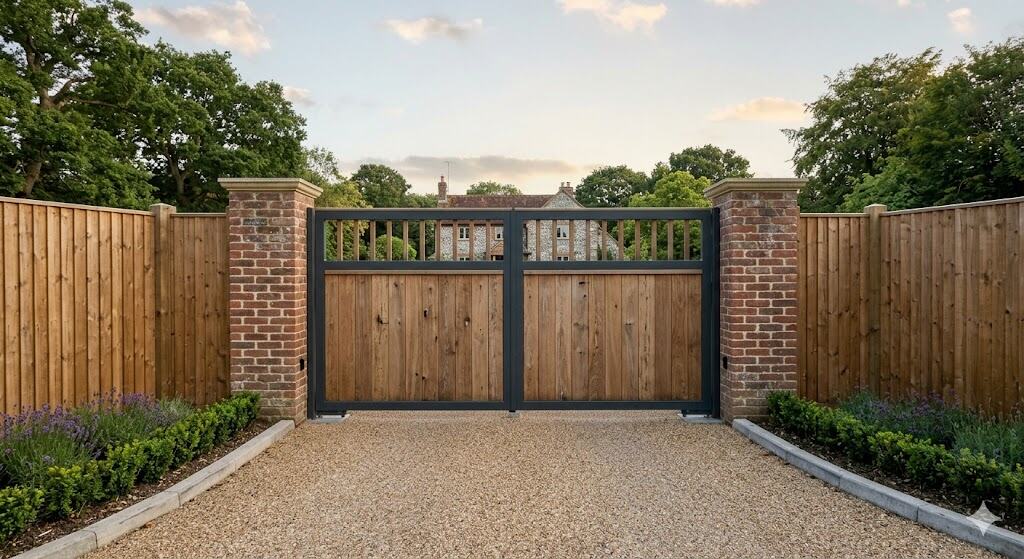
Do I Need Planning Permission
For Gates in Hampshire?
In many cases, driveway gates can be installed without planning permission, but height, location, highway visibility, listed buildings and conservation areas can change the answer. This guide explains the main rules before you start a gate, fence or automated entrance project.
Most Gates Do Not Need Planning Permission — But Some Do
In England, many gates, fences and walls fall under permitted development if they stay within height limits and are not affected by special restrictions. The two key measurements are usually 1 metre and 2 metres.
Planning permission is normally more likely to be needed where a gate, fence or wall is next to a highway used by vehicles, where it exceeds the permitted height, where the property is listed, or where conservation-area controls or previous planning conditions apply.
If the entrance is close to the road, next to a pavement, on a visibility-sensitive corner, or part of a listed or historic property, it is sensible to check before work starts.
The 1 Metre Rule and the 2 Metre Rule
The most important planning question is usually where the gate sits and how high it will be.
The 1 Metre Rule
If a gate, fence or wall is next to a highway used by vehicles, planning permission is generally needed if it would be over 1 metre high. This can include front boundaries next to roads and, in some cases, boundaries beside pavements or highway land.
The 2 Metre Rule
Away from a highway, gates, fences and walls are generally allowed up to 2 metres high without planning permission, provided there are no other restrictions such as listed-building controls, Article 4 directions, covenants or previous planning conditions.
When You Should Be More Careful
Listed buildings and properties within the curtilage of a listed building need particular care. In those cases, planning permission or listed building consent may be required even where a similar gate would normally be allowed elsewhere.
Conservation areas can also create extra considerations, especially where an existing wall, fence or gate contributes to the character of the street. Article 4 directions or previous planning conditions can remove some permitted development rights.
You should also consider visibility. Even if a gate height appears acceptable, setting the gates back from the road may be sensible so vehicles can pull clear of the highway while waiting for the gates to open.
Do Electric Gates Need Planning Permission?
Electric gates generally follow the same planning height principles as manual gates. The fact that a gate is automated does not automatically mean planning permission is needed.
However, electric gates create extra design considerations. The entrance needs enough space for vehicles to wait safely, the gate movement must not obstruct the highway, and the automation must be installed with appropriate safety measures.
For powered gates, the planning question and the safety question are separate. A gate may be acceptable in planning terms but still need proper safety design, including suitable automation, access control, sensors, safety edges and commissioning.
Planning Permission Does Not Prove a Gate Is Safe
Planning rules mainly deal with development, height, appearance, highway impact and local planning controls. They do not replace the need for a safe powered gate installation.
If the gate is automated, it should be designed, installed and commissioned around the site-specific safety risks. We follow HSE powered gate safety guidance when specifying and installing electric gate systems.
A properly planned entrance should consider both sides: whether the design needs planning permission and whether the finished automated gate system is safe to use.
Planning Permission for Gates FAQs
Common questions about gate height, driveway entrances, electric gates, highways, listed buildings and conservation areas.
Do I need planning permission for driveway gates?
You may not need planning permission if the gates are within permitted height limits and no special restrictions apply. Planning permission is more likely to be needed if the gates are over 1 metre high next to a highway used by vehicles, over 2 metres high elsewhere, or affected by listed-building, conservation-area or planning-condition controls.
How high can driveway gates be without planning permission?
As a general rule in England, gates, fences or walls can be up to 2 metres high away from a highway. If they are next to a highway used by vehicles, the limit is generally 1 metre before planning permission is needed.
Do electric gates need planning permission?
Electric gates usually follow the same height and location rules as manual gates. Automation does not automatically create a planning requirement, but the gate still needs to be safely designed, installed and commissioned.
Do listed buildings need consent for new gates?
Listed buildings and land within their curtilage can require listed building consent or planning permission for changes to gates, walls or boundaries. Always check before carrying out work on a listed property.
Do conservation areas change the rules?
They can. Conservation areas, Article 4 directions and previous planning conditions may restrict changes that would normally be permitted elsewhere. Local planning authority guidance should be checked before work starts.
Should gates be set back from the road?
Setback is often sensible where vehicles need to wait while the gate opens. It can help avoid blocking the highway and may improve visibility and safety at the entrance.
Book a Proper Gate Survey.
We can assess your entrance, explain the practical design options, and help you understand whether planning, highway position, automation safety or access control may affect the project.